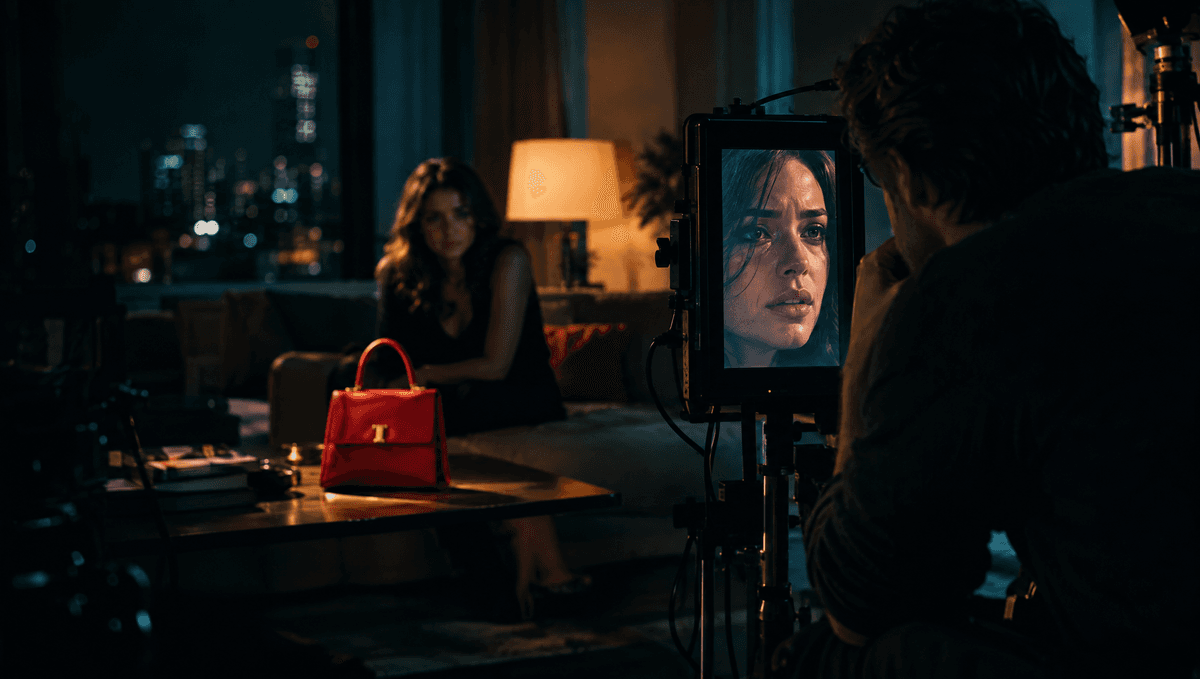
A branded micro drama is a scripted vertical series that a brand owns, with the product written into the plot, and in 2026 it became a format brands can actually buy. Sensor Tower counted more than 850M short drama app downloads in Q1 2026, up 140% year on year, and Marc Jacobs, P&G's Native, Google Pixel and Crocs have all launched series to meet that audience.
What is a branded micro drama, and how is it different from an ad?

A branded micro drama is a short scripted show, not a commercial. It runs as a vertical series of very short episodes, each ending on a hook, and the brand pays for it, owns it and writes its product into the story.
The episodes are tiny. The Cannes Lions session on the format in June 2026 talked about 70-second episodes, and P&G's Native series The Golden Pear Affair ran 50 episodes, most under two minutes, Variety reported.
Brands treat these as shows with a next episode. When Marc Jacobs launched The Scene in April 2026, starring Rachel Sennott, it called the film:
“the first installment in an ongoing series of scripted micro-dramas”
Marc Jacobs, via PR Newswire, April 2026.
That framing is the point. A broadcast slot buys you 30 seconds. Variety wrote that The Golden Pear Affair “functions as an 80-minute ad for Native”, which is feature-film time with one brand, spent by people who chose to keep watching.
Here's how it changes our work. In an ad, the product is the payoff: the last shot, the pack, the line. In a series the product moves the plot. A swapped bag, a shoe charm, a scent someone recognizes across a room. So we write, cast and storyboard differently from day one, and we run micro drama episodes and vertical video production as a series pipeline, not as an ad shoot with extra setups.
Why are brands making vertical series instead of ads in 2026?

Brands are funding vertical series because the audience already binges them, platforms started selling placements for them this year, and viewers mind brands inside them far less than they mind ad breaks.
Start with scale. Sensor Tower's State of Short Drama Apps 2026 counts 850M+ downloads in Q1 2026, up 140% year on year, and about US$750M in in-app revenue, up 20%. DramaBox and ReelShort each took close to US$140M. By April 2026, people spent an average of 25 minutes a day in these apps, up 85% from January 2025, against about 35 minutes for OTT streaming.
“users spending nearly 6x more time in short drama apps than a year ago”
Sensor Tower, State of Short Drama Apps 2026, June 2026.
And people pay. Micro dramas made US$1.3B in the US in 2025, mostly paid directly by viewers, according to Business Insider figures cited by Social Media Today. Nobody has ever paid to see the next ad.
The attitude data matters most for vertical drama advertising. In research cited by LBB Online with Meta in October 2026, only 20% of viewers said vertical drama carries too many ads, half the share who say that about broadcast TV. And 45% said a brand featured in a vertical drama would make them more likely to buy.
“The episodes are short but the relationship is long”
LBB Online, October 2026.
Earned attention is moving too. Vokode reports that Launchmetrics measured US$2.5M in media impact value for branded micro dramas in March 2026, against US$30,000 a year earlier.
What changed in 2026, month by month
- April: Marc Jacobs launched The Scene as the first episode of an ongoing series.
- May: Google's 100 Zeros and Range Media Partners announced micro dramas in development from Mike Fleiss, Simon Fuller and McG (Variety).
- June 24: Cannes Lions ran The Microdrama Boom, with speakers from Second Rodeo and My Drama and creator Hannah Stocking.
- June 29: TikTok added brand Mini Dramas to its Growth Max ad product (Social Media Today).
- October: Native's series became one of the first brand-funded shows on Instagram's new series feature (LBB Online).
“The creator economy has entered its scripted era, and it's worth billions.”
Cannes Lions, The Microdrama Boom session page, June 2026.
The return visit is what a spot can't buy. Every episode asks the viewer to come back tomorrow, so every episode has to win its opening seconds again. We've written about why every episode lives or dies in the first three seconds. In a series, that rule applies 14 or 50 times over.
Which brands launched micro dramas in 2026, and what did they get right?

Fashion, CPG, tech and retail brands all shipped series in 2026, and the ones that landed gave the product a job inside the story instead of a moment at the end. These are the brand microdrama examples we keep pointing clients to.
- Marc Jacobs, The Scene and The Swap. The Scene (April 2026) starred Rachel Sennott. In The Swap (August 2026), Rowan Blanchard and Jemima Kirke play two guests who leave a runway show with each other's identical Scene Bags, so the same bag drives a second story under the Question Marc platform (Drop Media). What they got right: one product, two plots.
- P&G Native, The Golden Pear Affair. 50 episodes, most under two minutes, with Native products throughout (Variety). What they got right: committing to app-length storytelling.
- Google Pixel and Unwell, Moving On. A 14-episode vertical series starring Alex Cooper, released on YouTube in June 2026 as a spoof of scripted series tropes (TheWrap). What they got right: a host with an audience, and a wink at the genre.
- Crocs, Charmed to Meet You. Five episodes on ReelShort that reached the app's top ten around Valentine's Day 2026 (Hollywood Branded). What they got right: going where drama viewers already are.
- Albertsons and P&G, Rico's Tacos. One to two minute episodes shot inside Albertsons stores with real store associates as co-stars, now sold by Albertsons Media Collective as a retail media product (Future Commerce). What they got right: shooting where the product is bought.
- Nykaa Wanderlust, Hotel Wanderlust. A six-episode series made with SW Network in India, launched September 2026 (Buzzincontent).
- VML Bangkok. An insurance micro drama about a young woman's bad luck with her car and her love life, listed among the 2026 Cannes Lions winners by Ad Age.
Our reading of the list: most brand series run five to 14 episodes. App series run far longer, and only P&G went near app length with 50. That's a pattern we see across these launches, not a measured statistic, but it's where we'd start a first series.
Where should a branded micro drama live: TikTok, Instagram, YouTube or a drama app?
Choose the platform before you write a line, because it sets episode length, how hard each cliffhanger has to hit and how you frame every shot.
- TikTok. Since June 29, 2026, brands can boost Mini Dramas through Growth Max. TikTok also runs a Minis section and a separate drama app, PineDrama, launched in the US and Brazil in early 2026.
- Instagram. The new series feature, where Native was among the first brand-funded shows.
- YouTube. Google Pixel released all 14 episodes of Moving On there, and Marc Jacobs' The Swap was described as YouTube-first.
- Drama apps. Crocs went to ReelShort, which Sensor Tower names as the US leader in revenue and engagement.
“TikTok Mini Dramas allows brands and marketers to build and publish episodic drama content directly on TikTok.”
TikTok, as quoted by Social Media Today, June 29, 2026.
From our edits: a series built for a drama app or the TikTok feed needs a harder cliffhanger at every cut, because the viewer decides in a swipe. On YouTube, where people binge a playlist, we get a little more room for a slower open. We shoot one master vertical by default and protect extra crops only when the media plan needs them. Framing for two shapes at once weakens the close-up, and the close-up is the genre.
How do you produce a branded micro drama that does not feel like an ad?

Write a show that works with the brand removed, then give the product one clear job in the plot. Everything on set serves those two rules.
Run the premise test first
“the premise has to work even if you strip the brand out of it entirely”
Hollywood Branded, August 2026.
The same piece describes Bilt's first micro drama, which failed because the characters were there to deliver brand information. The rebuild, on the same budget, went viral. Same money, different script.
Give the product a job, never a pitch
Marc Jacobs' bags get swapped. Crocs builds a Valentine's romance around a shoe charm. Native puts its scent inside the story. The product opens, carries and causes things. Nobody on screen explains why it's good.
What it takes on set
On our sets, the series that wrap on schedule share the same habits: tight scripts, one location per shooting day, and actors who can hold a close-up with a look. We storyboard vertical from the first frame, because 9:16 stacks faces and puts products in hands instead of centering them in a wide. And every episode's hook is written into the script, not hunted for in the edit.
Where AI helps, and where it doesn't
We use AI-assisted previs and background work to block scenes, extend sets and fix pickups faster. What it doesn't replace is performance and real places. Rico's Tacos works because real Albertsons associates stand in real aisles. A generated extra can't earn that trust.
What drives the budget
We found no reliable public budget figures for branded micro dramas, so we won't quote any. In our own quotes, cost moves with four things. Episode count, cast (a known face changes everything), number of locations, and how much of the world is built with AI rather than shot.
Measure it like a series
Judge a series on completion across episodes, return viewers, saves and follows, not one view count. Then track sales lift where a retailer can see it, which is what Albertsons' retail media model makes possible.
What should a brand do this quarter?
Use what's left of Q4 2026 to make one decision and one pilot plan, so a series can ship in early 2027.
- Watch three series end to end. One on ReelShort, Moving On on YouTube, The Golden Pear Affair on Instagram. Note where you swiped away.
- Write the premise on one page with the brand removed. If it doesn't hold, stop there.
- Give the product one job. One sentence: what it opens, carries or causes.
- Pick the platform, then the episode count. Five to 14 episodes is where most 2026 brand series sit.
- Set series metrics before the shoot. Completion, return viewers, follows, and a sales signal if you sell through a retailer with a media network.
If you want to see the finished thing before you plan, see the micro drama series we have made.
Branded micro drama FAQ
How many episodes should a branded micro drama have?
Start with five to 14. Crocs ran five, Nykaa Wanderlust six and Google Pixel 14, while P&G's Native went to 50, most under two minutes.
How much does a branded micro drama cost?
There are no reliable public figures. In our experience, cost follows episode count, cast, locations and the share of AI-built footage.
How do you measure whether it worked?
Track completion across episodes, return viewers, saves and follows. Add sales lift where a retail media network can measure it.
We're 351 Studio. We write, cast, shoot and cut vertical series for brands, from the premise test to the last cliffhanger. If you're weighing a branded micro drama for 2027, talk to us.